sunday i finally got around to watching "let's rock again" a documentary about joe strummer and his last band, the mescaleros. shot in 2001 and 2002, it follows joe and the band as they tour japan and the united states. strummer passed away not long after the japanese tour and the recording of a final mescaleros record, streetcore.
preview clip here...
we see joe and the band on the road promoting their second record, global a go-go. in japan he is greeted backstage and on the street by people positively verklempt at meeting a true music legend. i know i'd have had a hard time not being a gushing idiot had i had the chance to met him.
we also see something remarkable -- a completely unaffected and blase joe, doing a cold call to a south jersey radio station to promote the album and the show in atlantic city. we see joe on the a.c boardwalk trying to drum up business for the show. we see joe sitting on the street and just hanging out with some kids who are presumably no older than his own kids...just chatting with them about music as if in fact they are his kids. joe *fucking* strummer doing what neophyte artists do to get noticed. that should serve as an object lesson to any artist who thinks he's too big to interact with the hoi polloi.
i'm not too much affected by celebrity death and misadventure. paris hilton in jail means nothing to me. however, i was upset when kurt cobain killed himself...though i sometimes wonder if he -- or rather his legacy -- like james dean and marilyn monroe, was better served by dying young.
with joe, though...his sudden death, at a point in his life where he was still making good music, still passionate about his work...any time i hear his voice i get a little sad. in fact, i stumbled on this clip for his version of bob marley's "redemption song" recently...
it affects me every time i watch it...i'll cop to getting a bit misty-eyed (and it's playing now as i finish this post, and well, let's say the room's a bit dusty). check out the comments, especially the oldest ones. you can see what strummer and his music meant to people. and this comment by zeke7777 speaks to the scenes i mentioned in "let's rock again" where joe is tirelessly promoting his show and the record -- "joe strummer was never bigger than his smallest fan."
joe was a true original, a true punk in the sense of living his values, even if the values cost him material goods. the clash really were for a while "the only band that really matters", because their music was so infused with politics and passion. joe never wavered from that combination. check out the voice-over that starts the clip. that was joe...idealism and passion, not afraid to wear his heart on his sleeve.
Showing posts with label film. Show all posts
Showing posts with label film. Show all posts
Monday, August 13, 2007


Wednesday, July 04, 2007
do you really love me?
 sitting here on july 4, watching the last hour of the devil and daniel johnston. it's a moving account of a man wrestling with some serious demons. but the most disturbing thing to me is that while a few people in the new york & austin scenes seemed sincerely interested in helping johnston with his music and art, there was a "freak show waiting to happen" vibe going on at the live shows chronicled in the film. makes me wonder how many people were there almost hoping to see him melt down.
Tuesday, May 22, 2007
we will laugh and talk about the village green.
Though I am an avowed urbanite who loves living in a city environment, I also loves me my green space. Over the years I've been lucky enough (not by accident) to have lived within easy walking distance of awesome parks. Right now I live a block away from Dolores Park, a lovely piece of green with an amazing view.
 It's a place with lots of opportunity for some good people watching and photography, something I try to take advantage of regularly. There's almost always something happening, like this past weekend when the Loyd Family Players showed up for an impromptu (for us) afternoon concert and stroll through the park....
My morning commute starts with a walk through the park to BART, and even at the early hour of 6:50am (yes, oy) there's a handful of folks taking their dogs out for a romp. Sometimes there's a fitness bootcamp group doing situps, pushups or some stretching. Very quickly I began to recognize the regulars for that time of day...I like the consistency of seeing familiar faces, especially that early in the morning...helps one to feel community, even before sunrise. And of course, the walk home is great -- on sunny days during the months where the sun sets well after the end of the work day, the park is filled with people, often with their dogs.
Community is a central part of Dolores Park, whether it's thousands gathering to watch the World Cup final or for a Cinco de Mayo festival or to see the San Francisco Mime Troupe or for Film Night in the Park or just to hang out with dogs and friends.
Another wonderful downtown green space is Rittenhouse Square in Philadelphia. I was lucky enough to live around the corner from it for a couple of years, and within a short walk for a few other years. I spent many a weekend day there, reading, napping, people-watching...it's my favorite spot in the city.
So I was pleased to find on Netflix a documentary about the park, Rittenhouse Square: A Year in the Life of an American Park. It's not bad, though seems to focus too much on girl-watching in the park, almost getting into dirty-old-man territory...it had an uncomfortable leering quality to it (I went to college with one of the associate producers, I wonder if I should write and tell him). That aside it also highlighted one of the best things about the park, the musicians who use it as practice and performance space. I think the people who've decided to cave into a small cadre of uptight nimbys who moved to the park without a clue as to what makes it great and now crack down on busking and playing need to watch the film to understand how vital a role music plays in the life of Rittenhouse Square.
It's these urban and downtown green spaces that add to city life, provide for a wonderful counterpoint to the fast pace and the concrete and steel that mostly defines being in a city.
**Update...the Chronicle gets into the act, singing the praises of Dolores Park.
It's a place with lots of opportunity for some good people watching and photography, something I try to take advantage of regularly. There's almost always something happening, like this past weekend when the Loyd Family Players showed up for an impromptu (for us) afternoon concert and stroll through the park....  | 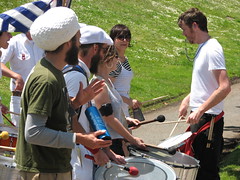 |
Community is a central part of Dolores Park, whether it's thousands gathering to watch the World Cup final or for a Cinco de Mayo festival or to see the San Francisco Mime Troupe or for Film Night in the Park or just to hang out with dogs and friends.
 |  |
 |  |
 |  |
Another wonderful downtown green space is Rittenhouse Square in Philadelphia. I was lucky enough to live around the corner from it for a couple of years, and within a short walk for a few other years. I spent many a weekend day there, reading, napping, people-watching...it's my favorite spot in the city.
So I was pleased to find on Netflix a documentary about the park, Rittenhouse Square: A Year in the Life of an American Park. It's not bad, though seems to focus too much on girl-watching in the park, almost getting into dirty-old-man territory...it had an uncomfortable leering quality to it (I went to college with one of the associate producers, I wonder if I should write and tell him). That aside it also highlighted one of the best things about the park, the musicians who use it as practice and performance space. I think the people who've decided to cave into a small cadre of uptight nimbys who moved to the park without a clue as to what makes it great and now crack down on busking and playing need to watch the film to understand how vital a role music plays in the life of Rittenhouse Square.
It's these urban and downtown green spaces that add to city life, provide for a wonderful counterpoint to the fast pace and the concrete and steel that mostly defines being in a city.
**Update...the Chronicle gets into the act, singing the praises of Dolores Park.
Saturday, January 20, 2007
it reminds me of the movies marty made about new york
as i mentioned a while back, i saw and loved martin scorcese's latest film, the departed.
in this piece in the washington post, stephen hunter speculates that scorcese might win a best director oscar for the departed, but that he doesn't really deserve it for this film, and that if he does win it'll essentially be a career award given under the guise of honoring work on the one film. hunter calls "the departed" the "least scorcesesque" of his films, that it seems like an homage made by a grad student film-maker.
hunter's first reason that it's not scorcesesque? well, it's not set in new york. seriously. that makes it not a marty movie. location. and also? well...
as a parallel example, i'll note that one of my favorte u2 records is zooropa. it is their most un-u2sque record, one reason why i love it so much (not that i don't love the band). they claimed pop would be a departure, but it was a tepid attempt at not being u2 and it ended up being a tepid u2 record. zooropa was just them making a record -- it didn't seem like they were thinking about being or not being u2.
what does this have to do with this review of the departed? well, hunter misses the point about what makes the film so good. it is precisely because scorecese doesn't wallow in stock scorcese-isms that the film works. it's a tight and unnerving story about lies and betrayal and people not being true to themselves, themes that scorcese has gone back to time and time again. i don't agree that it's as clean and striaght-up as hunter claims. moreoever, i defy you to find another director who could have taken the story (adapted from a korean film, infernal affairs) and made it as tense. who else could have gotten such fantastic performances from leonardo dicaprio and matt damon? yes, nicholson was not like de niro would have been in the role of frank costello, and what's wrong with that? why does hunter assume that scorecese must have de niro as his lead heavy? why can't scorcese move beyond being scorcese and bring different actors into his orbit?
does the departed deserve an oscar? well, the director's guild nominees are usually a good place to look at for the director's oscar, and for the dga award scorcese is up against the directors of babel, little miss sunshine, the queen and dreamgirls. i can't imagine that in a field so diverse (assuming the oscar list is similar) that a scorcese win would be thought of as cheap. maybe it is a career nod, but it's well deserved for the film in and of itself.
what i get from hunter's review is that he so much likes the scorcese of taxi driver and goodfellas that he can't accept that scorcese can make a good gangester movie without falling back on personal cliche. like the u2 who made zooropa didn't seem to be trying to be u2, the scorcese who made the departed seemed unconcerned with being scorcese. he just wanted to make a very good, tense gangster film. and he did.
in this piece in the washington post, stephen hunter speculates that scorcese might win a best director oscar for the departed, but that he doesn't really deserve it for this film, and that if he does win it'll essentially be a career award given under the guise of honoring work on the one film. hunter calls "the departed" the "least scorcesesque" of his films, that it seems like an homage made by a grad student film-maker.
hunter's first reason that it's not scorcesesque? well, it's not set in new york. seriously. that makes it not a marty movie. location. and also? well...
...it's not set among the Italian American Mafia subculture, and its characters seem by far a cooler lot than Scorsese's typical crew of hotheads and sociopath outsiders who yearn to belong and start killing when they don't. Nor does it have the hypnotic intensity that Scorsese brings to his typical film, that sense of hyper-realism that takes on a nightmarish clarity. It doesn't have Scorsese's old friend and collaborator Robert De Niro (who was off making his own film, "The Good Shepherd"), thus vacating a fat old-guy role for Jack Nicholson, who brought a different and distinctly non-Scorsese tone to the piece.ok, where to start?
as a parallel example, i'll note that one of my favorte u2 records is zooropa. it is their most un-u2sque record, one reason why i love it so much (not that i don't love the band). they claimed pop would be a departure, but it was a tepid attempt at not being u2 and it ended up being a tepid u2 record. zooropa was just them making a record -- it didn't seem like they were thinking about being or not being u2.
what does this have to do with this review of the departed? well, hunter misses the point about what makes the film so good. it is precisely because scorecese doesn't wallow in stock scorcese-isms that the film works. it's a tight and unnerving story about lies and betrayal and people not being true to themselves, themes that scorcese has gone back to time and time again. i don't agree that it's as clean and striaght-up as hunter claims. moreoever, i defy you to find another director who could have taken the story (adapted from a korean film, infernal affairs) and made it as tense. who else could have gotten such fantastic performances from leonardo dicaprio and matt damon? yes, nicholson was not like de niro would have been in the role of frank costello, and what's wrong with that? why does hunter assume that scorecese must have de niro as his lead heavy? why can't scorcese move beyond being scorcese and bring different actors into his orbit?
does the departed deserve an oscar? well, the director's guild nominees are usually a good place to look at for the director's oscar, and for the dga award scorcese is up against the directors of babel, little miss sunshine, the queen and dreamgirls. i can't imagine that in a field so diverse (assuming the oscar list is similar) that a scorcese win would be thought of as cheap. maybe it is a career nod, but it's well deserved for the film in and of itself.
what i get from hunter's review is that he so much likes the scorcese of taxi driver and goodfellas that he can't accept that scorcese can make a good gangester movie without falling back on personal cliche. like the u2 who made zooropa didn't seem to be trying to be u2, the scorcese who made the departed seemed unconcerned with being scorcese. he just wanted to make a very good, tense gangster film. and he did.
Sunday, January 07, 2007
no one gives it to you. you have to take it.
finally got around to seeing the departed, and wow...just wow. it's been a while since a film left me speechless upon leaving the theatre, but this one did.
it's tough to write too much without giving anything away, so i'll just say that leonardo dicaprio gives his best performance ever. he was great in basketball diaries and very good in catch me if you can. but here he's grown up and finally can carry off an adult role convincingly, without looking like a kid trying to play adult. the rest of the main cast -- matt damon, martin sheen and alec bldwin are very good, and jack nicholson is, well, jack nicholson.
scorcese makes great gangster films, and this is among his best.
it's tough to write too much without giving anything away, so i'll just say that leonardo dicaprio gives his best performance ever. he was great in basketball diaries and very good in catch me if you can. but here he's grown up and finally can carry off an adult role convincingly, without looking like a kid trying to play adult. the rest of the main cast -- matt damon, martin sheen and alec bldwin are very good, and jack nicholson is, well, jack nicholson.
scorcese makes great gangster films, and this is among his best.
Sunday, December 17, 2006
i know people whose idea of fun is throwing stones in the river in the afternoon sun
why haven't i been watching the office more regularly? huh? the christmas special is hilarious. even better than last year's christmas episode. interesting piece on the office in the dec 11th issue of the new yorker. i'd post a link, but it'll expire soon. if only the new yorker was better about their on-line content.
how is it that i found news gingrich oddly reasonable on meet the press this week? it's like in early 2004 when i as listening to npr, heard a guy who's voice i coulnd't palce, but he was saying some interesting stuff. i just about crashed my car when he was introduced as al sharpton. i still don't trust gingrich to not be a nutjob (his recent take on the possible need to curtail free speech is very worrisome), but he was ok today. and also on meet the press? tom friedman? dude, the sunni-shia thing erupting in iraq isn't just the result of what happened during hussein's rule, it's not baed on a 30-year build up of animosity. how ridiculously shallow an analysis, but then, nothing i shouldn't expect from him. and timmy? would it have killed you to have someone from the dem, liberal or progressive camp this week?
the netflix queue has been revived...jp and i watched a very long engagement friday. yes, a touching love story, yes, very beautifully and inventively shot. but also? reminds me of 12 angry men, in that mathilde was the only one among her inner circle to not take the evidence at face value. also, like 12 angry men and name of the rose, mathilde proved her case by way of some basic deductive reasoning, marshalling the evidence point by point.
i also watched broken flowers, arguably jim jarmusch's most mainstream film. i liked how he made bill murray's road trip geographically anonymous. the device was clearly used to mirror murray's quest -- just like he wasn't sure exactly what it was he was searching for, you were never exactly certain where it was he was during the search. i would like to see bill murray break his recent string of playing guys who look like they overdosed on prozec.
had the occassion to met the lovely and talented leah and simon of a girl and a boy, thanks to going to see simon's band play. they're both cool people and simon's band is a kick-ass honky-tonkin' quartet.
and yes...today was an amazing day to be out and about...

how is it that i found news gingrich oddly reasonable on meet the press this week? it's like in early 2004 when i as listening to npr, heard a guy who's voice i coulnd't palce, but he was saying some interesting stuff. i just about crashed my car when he was introduced as al sharpton. i still don't trust gingrich to not be a nutjob (his recent take on the possible need to curtail free speech is very worrisome), but he was ok today. and also on meet the press? tom friedman? dude, the sunni-shia thing erupting in iraq isn't just the result of what happened during hussein's rule, it's not baed on a 30-year build up of animosity. how ridiculously shallow an analysis, but then, nothing i shouldn't expect from him. and timmy? would it have killed you to have someone from the dem, liberal or progressive camp this week?
the netflix queue has been revived...jp and i watched a very long engagement friday. yes, a touching love story, yes, very beautifully and inventively shot. but also? reminds me of 12 angry men, in that mathilde was the only one among her inner circle to not take the evidence at face value. also, like 12 angry men and name of the rose, mathilde proved her case by way of some basic deductive reasoning, marshalling the evidence point by point.
i also watched broken flowers, arguably jim jarmusch's most mainstream film. i liked how he made bill murray's road trip geographically anonymous. the device was clearly used to mirror murray's quest -- just like he wasn't sure exactly what it was he was searching for, you were never exactly certain where it was he was during the search. i would like to see bill murray break his recent string of playing guys who look like they overdosed on prozec.
had the occassion to met the lovely and talented leah and simon of a girl and a boy, thanks to going to see simon's band play. they're both cool people and simon's band is a kick-ass honky-tonkin' quartet.
and yes...today was an amazing day to be out and about...
Tuesday, April 18, 2006
your heart is an empty room
Back in the fall I twice saw previews for The War Within and wanted very much to see the film. For whatever reason, it didn't get a wide theatrical release and I was excited to see it out on dvd, so added it to the Netflix queue. It makes a good companion piece to Paradise Now, which I saw a few weeks ago.
Written by and starring Ayad Akhtar, and directed by his Columbia Film School compatriot Joseph Castelo, The War Within is an intense look at the personal and interpersonal conflicts that arise when a Pakistani man, Hassan, is driven to wanting to commit an act of suicide terrorism on American soil.
Akhtar is sort of an accomplished unknown, clearly someone to watch. He's crafted a taut, tense script with believable dialogue. It's not preachy, it's not overwrought or maudlin. He plays Hassan full of brooding conviction, a man who bears the physical and mental scars of his time being interrogated and tortured in a Pakistani jail after having been snatched off the streets of Paris. Hassan isn't presented as a raving fanatic. It's almost as if he's an everyman who just happens to have come to the US on a mission to wreak havoc, death and destruction. He has become, though, loveless, unable to connect to anything or anyone save for his hatred of the west and his hope for salvation through the ultimate sacrifice to his cause.
There are glimpses as to why Hassan becomes radicalized, but they are fleeting and surface-level. Though it might have provided some more depth to have explored that territory a bit more, too much focus might have distracted from the central story, which revloves around how two boyhood best friends ended up in such different places, and what happens when they confront each other's new realities.
The relationship between Sayeed and Hassan has become strained. Sayeed is a physician, having accepted some Western ways and befriending Americans. Hassan views America as an evil oppressor. Still they bound together by old forces -- the obvious attraction between Hassan and Sayeed's sister Duri (played by the astonishingly beautiful Nandana Sen, daughter of Nobel Laureate economist Amartya Sen. She's fast becoming a Bollywood star) and the budding relationship that Hassan develops with Sayeed's impressionable young son Ali. In a key moment, Sayeed grdugingly allows his friend, who he by then knows to have become orthodox, to teach Ali how to pray.
It's not perfect, but it is often gripping, and you come to care about the characters, even Hassan, as you hope that he lets go of his hate and accepts what could be a fulfilling life among good friends in a land that offers him, a Western educated (schooled in the US and France) engineer, plenty of opportunity.
As I've written before, seeing and being moved by a film like this is not any tacit or explicit affirmation of the motives of terrorists. This kind closed-mindedness, given national voice by the likes of Charles Krauthammer, shows a fundamental misundertanding of one of the main purposes of art -- to make us confront our interpretations of reality and understand why we think the way we do and understand why others might come away with a completely different view of the same reality.
Written by and starring Ayad Akhtar, and directed by his Columbia Film School compatriot Joseph Castelo, The War Within is an intense look at the personal and interpersonal conflicts that arise when a Pakistani man, Hassan, is driven to wanting to commit an act of suicide terrorism on American soil.
Akhtar is sort of an accomplished unknown, clearly someone to watch. He's crafted a taut, tense script with believable dialogue. It's not preachy, it's not overwrought or maudlin. He plays Hassan full of brooding conviction, a man who bears the physical and mental scars of his time being interrogated and tortured in a Pakistani jail after having been snatched off the streets of Paris. Hassan isn't presented as a raving fanatic. It's almost as if he's an everyman who just happens to have come to the US on a mission to wreak havoc, death and destruction. He has become, though, loveless, unable to connect to anything or anyone save for his hatred of the west and his hope for salvation through the ultimate sacrifice to his cause.
There are glimpses as to why Hassan becomes radicalized, but they are fleeting and surface-level. Though it might have provided some more depth to have explored that territory a bit more, too much focus might have distracted from the central story, which revloves around how two boyhood best friends ended up in such different places, and what happens when they confront each other's new realities.
The relationship between Sayeed and Hassan has become strained. Sayeed is a physician, having accepted some Western ways and befriending Americans. Hassan views America as an evil oppressor. Still they bound together by old forces -- the obvious attraction between Hassan and Sayeed's sister Duri (played by the astonishingly beautiful Nandana Sen, daughter of Nobel Laureate economist Amartya Sen. She's fast becoming a Bollywood star) and the budding relationship that Hassan develops with Sayeed's impressionable young son Ali. In a key moment, Sayeed grdugingly allows his friend, who he by then knows to have become orthodox, to teach Ali how to pray.
It's not perfect, but it is often gripping, and you come to care about the characters, even Hassan, as you hope that he lets go of his hate and accepts what could be a fulfilling life among good friends in a land that offers him, a Western educated (schooled in the US and France) engineer, plenty of opportunity.
As I've written before, seeing and being moved by a film like this is not any tacit or explicit affirmation of the motives of terrorists. This kind closed-mindedness, given national voice by the likes of Charles Krauthammer, shows a fundamental misundertanding of one of the main purposes of art -- to make us confront our interpretations of reality and understand why we think the way we do and understand why others might come away with a completely different view of the same reality.
Thursday, March 23, 2006
i'll follow you into the dark
A few weeks ago I wrote about a few Oscar nominated movies that sent Washington Post columnist Charles Krauthammer into a tizzy. I finally got to see one of them, Paradise Now, which Krauthammer called a "sympathetic portrayal of two suicide bombers". The film centers on Khaled and Said, two friends living in the West Bank town of Nablus, tapped to go on a mission to Tel Aviv.
Contrary to Krauthammer's assertion (and as proof that he probably didn't see the film) it's far from a sympathtic portrayal of the Palestinian resistance movement and the use of suicide bombing as an effective means of insurgency. It shows the human side of an action that most of us only experience the end result of via news outlets. Paradise Now brings to life not only the bombers, but the people they leave behind.
The film certainly has harsh things to say about how the Israelis treat West Bank Palestinians. It by no means, however, shows the resistance as a pure endeavor. The men leading the cells, those who send young men off to die, are not given a flattering portrayal -- Jamal in particular comes off as a cross between a smarmy and manipulative televangelist and used-car salesman...feeding his recruits an ersatz spirituality dressed up in promises of rewards in heaven. He is, thanks to one very effective shot, cast almost as a Judas to the cause of Palestinian self-rule.
Taken apart from its specific context, the film is as much about the fine line between conviction and doubt. In context it gives voice to those left behind, showing them to wish more that their loved ones were still with them rather than having willfully died and killed for a cause. The two lead actors, particularly Kais Nashef who plays Said, are riveting. The dialogue never gets too maudlin and the preachiness is kept to a minimum. Worth a spot high up on your netflix queue. Up next for me is The War Within, which covers similar ground but set in the context of a planned attack in New York City.
Contrary to Krauthammer's assertion (and as proof that he probably didn't see the film) it's far from a sympathtic portrayal of the Palestinian resistance movement and the use of suicide bombing as an effective means of insurgency. It shows the human side of an action that most of us only experience the end result of via news outlets. Paradise Now brings to life not only the bombers, but the people they leave behind.
The film certainly has harsh things to say about how the Israelis treat West Bank Palestinians. It by no means, however, shows the resistance as a pure endeavor. The men leading the cells, those who send young men off to die, are not given a flattering portrayal -- Jamal in particular comes off as a cross between a smarmy and manipulative televangelist and used-car salesman...feeding his recruits an ersatz spirituality dressed up in promises of rewards in heaven. He is, thanks to one very effective shot, cast almost as a Judas to the cause of Palestinian self-rule.
Taken apart from its specific context, the film is as much about the fine line between conviction and doubt. In context it gives voice to those left behind, showing them to wish more that their loved ones were still with them rather than having willfully died and killed for a cause. The two lead actors, particularly Kais Nashef who plays Said, are riveting. The dialogue never gets too maudlin and the preachiness is kept to a minimum. Worth a spot high up on your netflix queue. Up next for me is The War Within, which covers similar ground but set in the context of a planned attack in New York City.
Saturday, March 11, 2006
dysfunction junction
Finally got around to seeing Capote last night, and for discussion purposes it's a good complement to The Squid and the Whale which I saw a couple of weeks ago. Both center on insufferably egotistical New York-based writers, albeit one with a bit more notoriety and success than the other. Both Jeff Daniels's Bernard Berkman and Truman Capote are real people, the Berkman character fictional but apparently not too far removed from the real-life father of Squid writer and director Noah Brumbach (who wrote The Life Aquatic with Steve Zissou, which also deals heavily with paternal-filial relations and egomaniac creative types.
There's not a scene in Squid which isn't uncomfortable to watch. From the screwed up family dynamic that's set up in the first scene on the tennis court, to the pretension and smug stupidity of Berkman and his eldest son, to the mom's philandering, to the youngest son's acting out with alcohol and masturbation (and speaking of uncomfortable, the acts are portrayed fairly graphically, which is cringe-worthy as the kid {played by Kevin Kline and Phoebe Cates's son Owen) is all of about 10 years old..how do you direct that without self-consciousness)...the film is one big trip to the therapist's couch for Brumbauch, and entire skeletons are hauled out of the closet for the audience to examine. Plenty of films have dealt with divorce, and many from the point-of-view of the kids...none that I remember have done so in a way that either sparks instant recognition for anyone who's been through some messy family stuff or provides a "there but for the grace of god" moment for people who grew up in happy families. And speaking of child stars, or at least former ones now grown up...Anna Paquin plays a grad student who sleeps with the elder Berkman while she teases his son. Anna Paquin, the little girl from The Piano. When did she grow up?
The real-life Truman Capote doesn't come off very well. He's portrayed as a self-absorbed drama-queen who uses Perry Smith (and to a lesser extent Richard Hickock) to write "In Cold Blood". At first his affection for Smith is apparently genuine, as he thinks Smith and he are both cut from the same cloth, and Smith just had the worse luck and made the poor choices to be weak and a criminal. The worm turns when Capote realizes that Smith is as much using him to get access to lawyers and beat the rap when it's obvious that Smith and Hickock are guilty. A fantastic juxtaposition is the scene where Capote is basking in the adulation from a well-received public reading from the unfinished book while Smith sees a fellow death-row inmate be walked into the hanging warehouse and later wheeled out on a back-hoe, one arm hanging off the lip of the well. Each sees his future played out, the consequences of the murder taking their lives in starkly different directions. In the end Capote can't wait for Smith and Hickock to meet the hangman so that he can finish his book. The depth of Capote's self-absorption comes when longtime friend Harper Lee is celebrating her own success, the film premiere of "To Kill a Mockingbird". Capote can't even be bothered to offer her sincere congratulations, preferring to wallow in his own martini-induced miasma of self-pity, churlishly lamenting that the stays of execution are preventing him from being done with the book.
Regarding the Oscar-worthiness of Philip Seymour Hoffman's performance...well, it's always hard to be totally objective after the fact. I mean, I'm watching it knowing he won, how can that not affect my own view? Three of the nominees for Best Actor were for roles where the actors portrayed real people who had plenty of visual evidence left as to their mannerisms. While it's certainly a challenge to portray a real person regardless whether the actor interprets or imitates, I thought Heath Ledger's performance was all the more amazing because he had to create his character out of whole cloth. And his character was much more complex than Joaquin Phoenix's Johnny Cash or PHS's Truman Capote.
There's not a scene in Squid which isn't uncomfortable to watch. From the screwed up family dynamic that's set up in the first scene on the tennis court, to the pretension and smug stupidity of Berkman and his eldest son, to the mom's philandering, to the youngest son's acting out with alcohol and masturbation (and speaking of uncomfortable, the acts are portrayed fairly graphically, which is cringe-worthy as the kid {played by Kevin Kline and Phoebe Cates's son Owen) is all of about 10 years old..how do you direct that without self-consciousness)...the film is one big trip to the therapist's couch for Brumbauch, and entire skeletons are hauled out of the closet for the audience to examine. Plenty of films have dealt with divorce, and many from the point-of-view of the kids...none that I remember have done so in a way that either sparks instant recognition for anyone who's been through some messy family stuff or provides a "there but for the grace of god" moment for people who grew up in happy families. And speaking of child stars, or at least former ones now grown up...Anna Paquin plays a grad student who sleeps with the elder Berkman while she teases his son. Anna Paquin, the little girl from The Piano. When did she grow up?
The real-life Truman Capote doesn't come off very well. He's portrayed as a self-absorbed drama-queen who uses Perry Smith (and to a lesser extent Richard Hickock) to write "In Cold Blood". At first his affection for Smith is apparently genuine, as he thinks Smith and he are both cut from the same cloth, and Smith just had the worse luck and made the poor choices to be weak and a criminal. The worm turns when Capote realizes that Smith is as much using him to get access to lawyers and beat the rap when it's obvious that Smith and Hickock are guilty. A fantastic juxtaposition is the scene where Capote is basking in the adulation from a well-received public reading from the unfinished book while Smith sees a fellow death-row inmate be walked into the hanging warehouse and later wheeled out on a back-hoe, one arm hanging off the lip of the well. Each sees his future played out, the consequences of the murder taking their lives in starkly different directions. In the end Capote can't wait for Smith and Hickock to meet the hangman so that he can finish his book. The depth of Capote's self-absorption comes when longtime friend Harper Lee is celebrating her own success, the film premiere of "To Kill a Mockingbird". Capote can't even be bothered to offer her sincere congratulations, preferring to wallow in his own martini-induced miasma of self-pity, churlishly lamenting that the stays of execution are preventing him from being done with the book.
Regarding the Oscar-worthiness of Philip Seymour Hoffman's performance...well, it's always hard to be totally objective after the fact. I mean, I'm watching it knowing he won, how can that not affect my own view? Three of the nominees for Best Actor were for roles where the actors portrayed real people who had plenty of visual evidence left as to their mannerisms. While it's certainly a challenge to portray a real person regardless whether the actor interprets or imitates, I thought Heath Ledger's performance was all the more amazing because he had to create his character out of whole cloth. And his character was much more complex than Joaquin Phoenix's Johnny Cash or PHS's Truman Capote.
Wednesday, January 04, 2006
some kind of monster
i'll start this by saying that i'm not a metallica fan. have never dug their music. so why use netflix rentals for the documentary "some kind of monster", which details the making of metallica's "st. anger" album? because the reviews were pretty good and i have some experience in the music biz, including in the studio and dealing with fucked up band dynamics.
i'd read the stories about how hetfield and ulrich were major assholes -- control freaks who didn't let kirk hammett or jason newstead have much in the way of creative input, how they mercilessly hazed newstead after he took over for the dead cliff burton. if you read the rock press you read the 'alcoholica' stories, you read about the groupies. ulrich makes news going after napster. but you also read about an incredibly successful band.
so it's quite a shock that the movie starts with conflict, newstead leaving the band just before they commence recording what would become "st. anger". also, the band has brought in a $40K/month life-performance coach to help them with their issues. the sessions begin with nothing demoed, evidently a departure for them. but hey, they're rich, they can afford to dick around in the studio. also, the plan is for everyone to contribute both musically and lyrically, again a new thing.
the sessions aren't yielding much but fighting between hetfield and ulrich, with hammett playing his usual peace-maker. after a particularly bad fight, hetfield storms out of the studio. he doesn't come back for a year, going into rehab. upon his return the band slog thru recording and finish. they also hire a new bass player, rob trujillo, from ozzy osbourne's band.
the crux of the film is not the artistic process itself, but the interplay between the art and personal reconciliation. simply put, these guys have major issues in how they deal with each other. their lives having come to a crossroads of age {they're all at or near 40} and their material wealth great and musical legacy strong, they need to find out how to be challenged to create and how to get out of the dysfunctional rut that will keep them from moving forward artistically.
there are some powerful scenes from therapy sessions and meeting, scenes that make the viewer feel like an intruder. but they resonate with real pain and emotion. notable is a meeting between dave mustaine and lars ulrich. mustaine, kicked out of the band almost 20 years ago, *still* harbors major resentment towards hetfield and ulrich for the way they dumped him {though he acknowledges he deserved it, given his alchoholism..which is saying something considering how much these guys drank}. despite that mustaine's band megadeath sold millions and millions of records, he still acts like a wounded child, his self-esteem stuck at being measured in terms of his relationship to metallica's success and that he wasn't there for it.
hetfield's post-rehab change is remarkable -- he emerges as this sensitive, caring family man who openly professes love for his bandmates. the directors do a great job of developing his character.
it's a layered and complex film about real relationships. and from experience i know that being in a band is very much like a marriage or other romantic relationship. you put so much of yourself out there, you're so vulnerable and the only ting that keeps you going is your trust in your partner{s}.
so get the movie. make sure to also get the bonus disc {shipped separately if via netflix}. it's an amazing piece of work. this non-fan still doesn't like metallica's music that much, but i came away with a fair amount of respect for them, in the sense that they embarked on a risky path of personal and artistic change, and doubled that risk by letting cameras chronicle every minute.
i'd read the stories about how hetfield and ulrich were major assholes -- control freaks who didn't let kirk hammett or jason newstead have much in the way of creative input, how they mercilessly hazed newstead after he took over for the dead cliff burton. if you read the rock press you read the 'alcoholica' stories, you read about the groupies. ulrich makes news going after napster. but you also read about an incredibly successful band.
so it's quite a shock that the movie starts with conflict, newstead leaving the band just before they commence recording what would become "st. anger". also, the band has brought in a $40K/month life-performance coach to help them with their issues. the sessions begin with nothing demoed, evidently a departure for them. but hey, they're rich, they can afford to dick around in the studio. also, the plan is for everyone to contribute both musically and lyrically, again a new thing.
the sessions aren't yielding much but fighting between hetfield and ulrich, with hammett playing his usual peace-maker. after a particularly bad fight, hetfield storms out of the studio. he doesn't come back for a year, going into rehab. upon his return the band slog thru recording and finish. they also hire a new bass player, rob trujillo, from ozzy osbourne's band.
the crux of the film is not the artistic process itself, but the interplay between the art and personal reconciliation. simply put, these guys have major issues in how they deal with each other. their lives having come to a crossroads of age {they're all at or near 40} and their material wealth great and musical legacy strong, they need to find out how to be challenged to create and how to get out of the dysfunctional rut that will keep them from moving forward artistically.
there are some powerful scenes from therapy sessions and meeting, scenes that make the viewer feel like an intruder. but they resonate with real pain and emotion. notable is a meeting between dave mustaine and lars ulrich. mustaine, kicked out of the band almost 20 years ago, *still* harbors major resentment towards hetfield and ulrich for the way they dumped him {though he acknowledges he deserved it, given his alchoholism..which is saying something considering how much these guys drank}. despite that mustaine's band megadeath sold millions and millions of records, he still acts like a wounded child, his self-esteem stuck at being measured in terms of his relationship to metallica's success and that he wasn't there for it.
hetfield's post-rehab change is remarkable -- he emerges as this sensitive, caring family man who openly professes love for his bandmates. the directors do a great job of developing his character.
it's a layered and complex film about real relationships. and from experience i know that being in a band is very much like a marriage or other romantic relationship. you put so much of yourself out there, you're so vulnerable and the only ting that keeps you going is your trust in your partner{s}.
so get the movie. make sure to also get the bonus disc {shipped separately if via netflix}. it's an amazing piece of work. this non-fan still doesn't like metallica's music that much, but i came away with a fair amount of respect for them, in the sense that they embarked on a risky path of personal and artistic change, and doubled that risk by letting cameras chronicle every minute.
Subscribe to:
Posts (Atom)


 Posts
Posts


